Last January, while still residing at our 1/8th acre urban lot, a cameoing sun struck the soggy ground and I was bitten by the gardening bug. We had a couple bags of potting soil lying about and my very first batch of homemade compost was looking dark and loamy, so I mixed it all up in the wheel barrow and grabbed the seed packets.
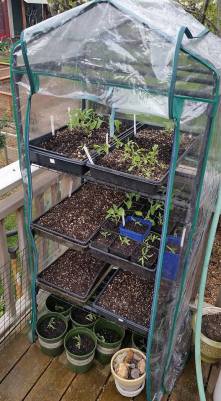
Tomatoes need a long growing season and heat. Around here that means months under some sort of plastic or glass. So, after seeding the furrowed rows of fluffy medium, I loaded up our $50 portable greenhouse with flats of tomato seeds.
Now, in the past I have not had so much luck with germination, and these seed packets were already a year or three old. I figured I’d just clean them out. Too, for watering, I used 5 gallon buckets to catch water off my garage, just as an experiment.
My Grandma used to say that her garden did better when it rained rather than when using the hose water to irrigate. And Grandma Berdell’s tomatoes were to die for! This surely has everything to do with the lack of chlorination in the rain water.
Well, two weeks later, with persistent moisture monitoring (but not overdoing it), I had around a 75% germination rate. Time to start thinning!
After about a month, the seedlings were moved from the flats to 4 and 6″ pots to give room for the roots. And there they stayed for a VERY long time. That’s because in March, our dream property come onto the market. Well, 4 times our dream property actually.
When planting these tomatoes, I had no idea, come late April, we would have 7 acres to work with. But, some part of me wonders whether these little starts were just hoping, perhaps knowing even that they’d be given all the room in the world.
Yes, they made the move. All 50 pots of leggy t’maters. And then they sat patiently for a few more weeks while we settled in and lightly tilled a few strips of pasture. We got them in the ground, with a little fertilizer (because this soil has not been prepared) and mulched them neatly to lock in the moisture and feed the creepy crawlies.
By July they were gangbusters and it was time to process.
The fall harvest
So far, we’ve canned red sauce, ketchup, and whole tomatoes. We’ve also made gallons of lacto-fermented salsa and countless caprese salads (moz and basil on sliced tomato with olive oil, salt, and pepper).
Gwen says it was an act of ‘radical hope’ planting that many seeds and that it may have led to this wonderful 7 acre outcome somehow by bending the space time continuum. I may have tapped into something, but it was probably just wishful thinking, but hey, how do I know? One thing is for sure…we will be having some killer Italian food this winter!
I’ll go ahead and call it what it is…a mid-life crisis. Some dudes get the hotrod, maybe take up skydiving, cross-fit, or some other exhilaratingly risky hobby. Myself, I’ve purchased way too much land and plan to farm it with almost no experience whatsoever.
Crazy?
Probably. Now, you should know that I can operate a shovel with a deftness and pizazz worthy of Bruce Lee’s nunchucks at the ping-pong table. As a former pro landscape constructor, I can move, retain, irrigate, trench, sculpt, and plant-out earth pretty good.
But, seven acres is around 56 times as large as the city lot that took Gwen and I 8 years to develop into an inspiring and decently edible landscape. So, by extrapolation, we will be 224 when this place is done…
Of course, a garden is never “done.” It is evolving. It is always in process. For better or for worse. And “better” in my mind is an ecological succession that steers towards more and more biodiversity. Enough of this and that to step in when needed to balance the scales. Not too much of one thing potentially susceptible to disease or attack.
It is my belief that a diverse succession starts at ground zero. In the dirt. In the soil, to be more specific. My definition of which is: an intricately structured, yet pliable playground for microorganisms that allow easier access to minerals and nutrients. You know, that spongy dark medium that holds moisture when its dry, but is never too saturated when its wet. The good stuff.
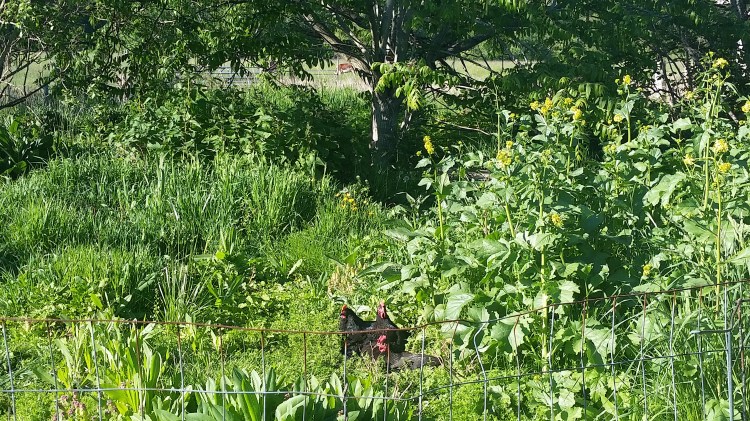
Now there’s not a lot of that good stuff here. Mostly we are compacted clay pasture and super weedy paddocks from past over-grazing. The chicken run has nearly turned to ammonium from the years and years of too much nitrogen.
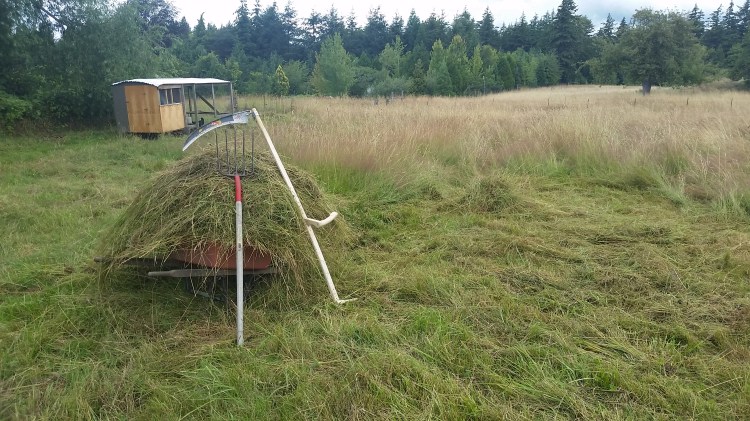
The hay-maker set-up; a nice way to harvest carbon.
That’s where the carbon comes in. Carbon is life. It comes in woody, weedy, grassy, leafy, buggy, and even fleshy. Well, we’ve got TONS of those things and especially the first two. I think of returning the excess carbon as feeding the soil, just like feeding our pigs or chickens.
On our previous urban 1/8th acre, once I gave up my war on the weeds and began returning all the excess organic material to the land, including and especially said weeds, the magic happened. Fertility went up. The need for irrigation went down. Balance and ease showed up little by little. I even began to see my once arch nemesis, horsetail, as an asset. (Word is, a tea from it will keep powdery mildew at bay – something I hope to put to science soon).
Too, I let the more desirable things go to seed and voilà! they came back the next year. No planting. Birds and squirrels buried other seed for me. Perennials like asparagus and fruit just kept on giving. My own work went way down. The garden’s production went way up. And the awe was simply keen as more and more order seemed to come out of the chaos.
On these seven green acres, there’s gonna be a heckuva lot of work to be done the first years, but I am confident that as time goes on, the workload will lessen as the natural systems take care of themselves more and more. After all, it makes sense that the more living things are in below the soil, the more there will be above.
This morning I got a call from the post office. They were calling to let me know that my package had arrived and was ready for pickup.
Delighted, I hung up and let my boss know that I had to take an early lunch to go pick up my chickens from the post office.
When I arrived at the bulk mail receiving warehouse, I could hear a cacophony as soon as I stepped in the door. It sounded like the whole warehouse was full of baby birds. Surely all that noise wasn’t coming from my birds?!
A stoic postal worker handed over the peeping box–she seemed neither amused nor irritated, and her indifference led me to understand that postal workers in the bulk mail room receive odder things than chickens on a daily basis.
“Well, they’re loud,” she said. “That means they’re not dead.”
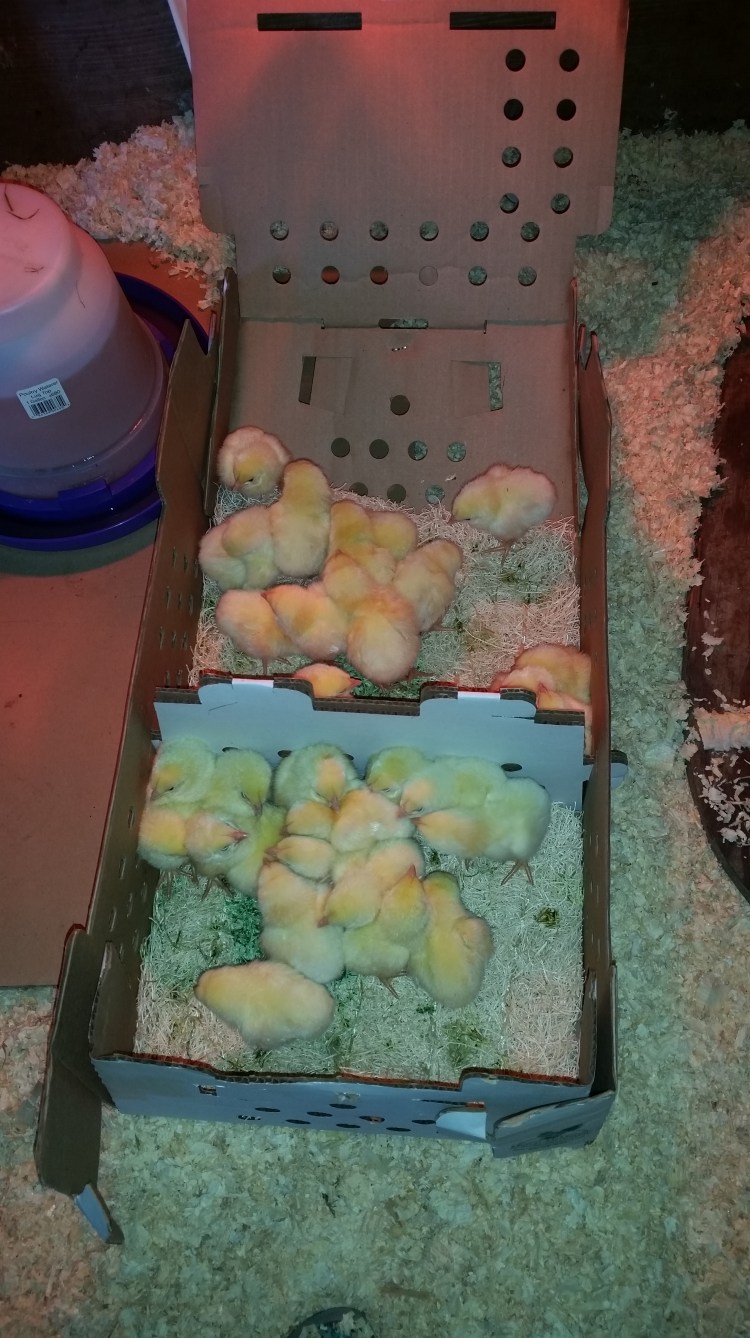
I nodded thoughtfully; her logic was sound. True enough, when I opened the box in the chick brooder, all 31 chicks were lively and thriving.
These 31 are in addition to the 16 we already have on the farm. (Four chickens made the move with us, and I added a dozen layer chicks to our flock within days of moving to the homestead. They should start laying soon!)
After a spring and summer of enormous learning curves and new endeavors, I wanted to add something to the homestead that felt like familiar territory. We’ve raised meat chickens before (in smaller numbers), and I’m pretty confident that we basically know what we’re doing.
Josh argued that we have been adding to the homestead nonstop since we moved here in May, and did we really need to add something else at this point? Especially more mouths to feed?
“But we’re out of chicken in the freezer,” I reasoned.
Other husbands might have said, “Then let’s go to the grocery store.” But not my husband, who nodded in resigned agreement. When you’re out of frozen chicken, what can you do but order a box of new chicks and grow some new ones?
In preparation for the arrival of the meatheads, Josh built a Salatin-style chicken tractor. The intention is to put the chicks out in the pasture as soon as they have their pin feathers and can stay warm, which is about 2-3 weeks for this breed. We’ll move the chicken tractor daily so that they’re always on fresh pasture, but they will also have pretty solid predator protection. We think it’s a good system for pastured chicken production in theory, but have yet to test it.
If all goes well, we’ll be selling our first farm products this fall! Eggs will come first in September, and the meat chickens will be ready to butcher in mid-October. If you’re local and want to be on the list for pastured non-GMO eggs or chicken, let me know!
There are numerous ways to solve almost any challenge, but the simplest approach involving the fewest steps and the least energy, materials, and time is always the most effective, long-term, viable solution.
-Ben Falk, The Resilient Farm and Homestead
Our neighbors invited us over for dinner last weekend, where we enjoyed a feast of the bounty of their homestead: heritage breed turkey, broccoli salad, carrots, blackberry crisp. Their property abuts ours on the back half, and they have a pretty good view of the goings on at our farmstead.They’ve been terrific mentors to us, and we’ll rely on them later this summer for their cider press, and next spring for pruning advice and help.
In the course of good conversation and last season’s apple cider, our neighbor said, “Yeah, I saw Josh scything the field the other day. I had to laugh. Yep, I’ve done things the hard way, too.”
We laughed, but Josh and I don’t entirely agree with him. The scythe seems like a very simple and logical solution to our problem, which is that our pasture needs to be cut.
For some context, we watched the property across the street get hayed over 4th of July week. They have 20 acres. I grew up in corn country in middle America, and although some people grew hay, it wasn’t as common, and I never saw it being harvested. So it was an education to watch what was involved in processing a bale of hay.
Over the course of the week, I observed the following:
Day 1: A mower pulled by a tractor cut down the hay, where it laid flat on the field like a blanket.
Day 2: Another attachment with rotating tines that I call the “fluffer” came along and fluffed up that flat hay into tufts, presumably so that it had air flow and could dry out a bit more. I’ve read that there are tractors that combine the cutting and fluffing into one step, but my neighbors didn’t have that.
Day 3: After drying for a couple of days, yet another attachment raked the fluffed hay into windrows.
Day 4: The hay baler. This attachment was huge and somehow scooped up those rows of hay and popped them out as rectangular bricks. I saw 3 people required at this stage: one to drive, one to stand on the back and keep an eye on the baler, and another to guide the bales to the ground, where hopefully they don’t break up too much when they land. At some point these bales are tied up with string, but I didn’t see this happen, so I’m not entirely sure how it’s done. Inside the baler, maybe?
Day 5-?: A crew of people rode around on a hay wagon, again pulled by the tractor, and loaded it up. In their field, this was the most manual process. One person thew the bales up to the wagon, another person stacked. But there are machines (loaders and stackers) that can do this job, too.
They drove that hay to a barn load after load after load, which took a few more days. At the barn, that hay was unloaded off the trailer and onto an escalator that conveyed each bale up to the hay loft at the top of the barn.
All told, it took our neighbors approximately 12 days to hay their 20 acres, from first cut to put up in the barn. Not every day was a full day, but I did see them out there at sunset a few times. This process required no fewer than 5 different pieces of farm equipment–6 if you include the tractor that pulled it all, which you should–and at least 4 people on the busy days.
Is that the easy way? Their equipment easily surpassed $100k in value, and it was old stuff that requires annual maintenance and repair. At a market price of $4/bale, how many years of haying does it take to recover the expense?
Enter the scythe.
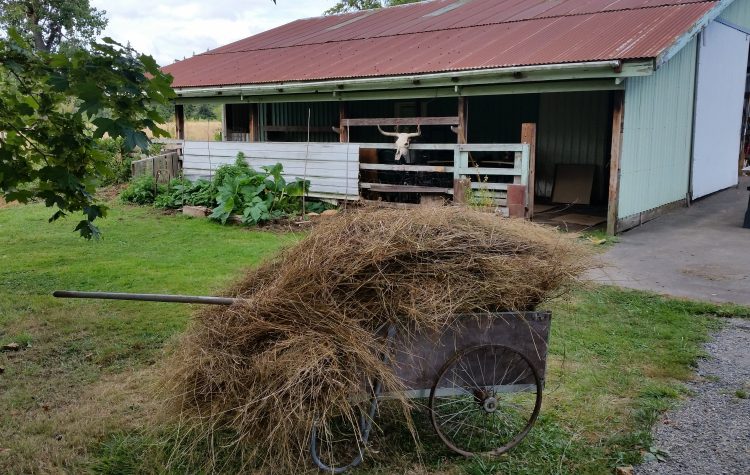
Josh is slowly haying our pasture the old way. He cuts it with a scythe, rakes it into piles, then hauls those piles away on a cart. The scythe cost $180 from Scytheworks in British Columbia. The only other necessary tool is a pitchfork, which doubles as a rake. Nothing is ever heavy enough or complicated enough to require 2 people (although 2 people with 2 scythes would make it go twice as fast!).
The only input is Josh’s time, and he’s a strapping lad and really enjoys it.
We don’t have any livestock to feed over the winter, so our hay is being hauled to weedy compacted ground that may be the future home of garden beds. We pile it on thickly, where it will decompose over the winter and build a top layer of soil. It will also drop seed that will come up in the spring; the new grass will compete with the noxious weeds, like morning glory and blackberry, and the roots will help break up the soil. When we eventually till it under for a garden, the tender green parts will add nitrogen to the soil.
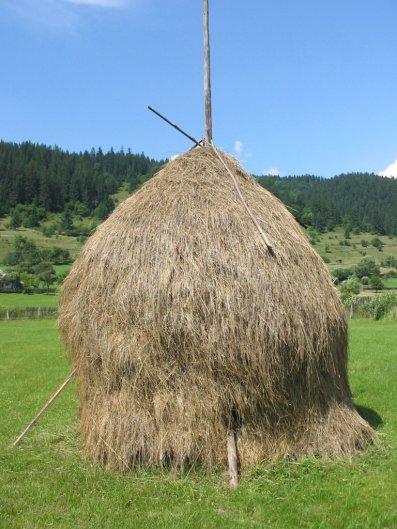
If we did need to store our hay for the winter, there are low-input ways to do that as well. The postcard-perfect haystack effectively dried and stored hay for centuries before the haybaler was invented in the 1940s. If we ever end up raising cattle over the winter, then we might try haystacks for storage.
By Paulnasca – Transferred from the English Wikipedia, CC BY 2.0
In a sense, our well-meaning neighbor was right: scything is hard work. But it’s also simple, and in permaculture principles, the simplest approach is usually the best one. Haying a field with numerous pieces of large and expensive machinery is also very hard work, but not at all simple.
Of course, there’s an even simpler option: buy a herd of lambs in early spring, pasture them through the summer so that they keep the grass trimmed but not scalped, and butcher in the fall so you don’t have to pay for winter feed. Maybe next year?
By Gerard Horenbout, Alexander & Simon Bening – Venedig, Biblioteca Marciana, Public Domain
We had a pig scare today. Big Boy stopped eating last night, and he laid down to sleep while the other 3 (Tugboat, The Corporal, and Number Two) fought over dinner. He’s a pig, so dinner should be the absolute best part of every day. Something was wrong. I went to bed feeling anxious, but there wasn’t anything I could do at 10 p.m. When I checked on him first thing in the morning, he flopped over onto his side and seemed reluctant to get up. He had a drink of water, but showed no interest in the carrots I brought for breakfast. His pointy piggy tongue was sticking out of his mouth.
Crap. We had a sick pig.
I called work to tell them I would be late and took a trip to the farm supply store to buy a veterinary thermometer. They didn’t have one, so I went to the grocery store pharmacy and bought a digital thermometer exactly like the one in my own medicine cabinet. “Quick Reading” it said. 15 seconds when used orally. 10 seconds for rectal.
“That’s good,” I thought. “I don’t think I’m going to get more than 10 seconds.”
Sure enough, when I came back to the paddock, Big Boy looked less lethargic and suddenly wary of me. I petted him and coaxed him over on his side, and, well…tried to take his temperature. The things you never thought you’d do on a Thursday morning before work.
But before I had the thermometer in more than an inch, he decided that he was having none of that, and he bolted up and ran away, suddenly not feeling so sick anymore. He retreated into his hut.
I left for work fretting about Big Boy. When I explained to coworkers that I’d spent the morning tending to a sick pig, many of them asked, “What do you do with a sick pig?”
“Exactly,” I said. “What do you do with a sick pig?” Sickness is on the list of problems you can’t anticipate, and just have to hope that you won’t have to deal with it. But then when it happens (because of course it will eventually), you have to figure it out. I found myself in this camp.
I had to figure out which vets in my county handle large animals (only 2, and it’s a very big county). I had to do some brainstorming about how to separate Big Boy (they hate being separated), and where to put him if he needed isolation. And then, I wondered what to do if the vet said that Big Boy was really sick and needed an antibiotic. Josh and I are firmly in the organic food camp, especially meat, and you can’t give organically raised animals antibiotics at any stage, if even if they’re not going to be slaughtered for years.
So how do organic meat producers deal with sick animals? In large organic meat operations, a sick pig is often destroyed. It’s usually not economical to treat it. But for a homesteader, when one sick pig equals a quarter of your production, culling it is a significant loss. But if you treat it, you lose the organic antibiotic-free status that brings such a high market price. What a dilemma.
I posed this question on the American Guinea Hog facebook group, a community that leans more toward the self-sufficient homesteader than the conventional pig farmer: “For those who are selling/raising organic or antibiotic-free pork: what do you do if one of your pigs gets sick?”
The initial responses gently admonished that pastured pigs in a clean environment shouldn’t get sick. I felt a bit judged, like I’d deliberately sprinkled H1N1 on this animal. But as the thread grew and long-timers weighed in, the general consensus was to try to treat it naturally, but if that fails, call a vet, give the pig the drug it needs to get better, and sell the meat for a little less as non-organic.
The whole experience really made me reflect on my values surrounding organic food. I know that some people refuse to take pharmaceutical medications when sick. I personally know several who won’t even take ibuprofen for a serious headache (Josh is one of them). But when I tried to extend that ethos to an animal in my care, I had a bit of a crisis of conscience. Who am I to decided for this animal that he should remain sick, or be subjected to herbal remedy experiments? He’s sick, and he doesn’t need to be. Shouldn’t I do whatever I can to make him feel better, even if it’s not in my “food ethic?” No, an antibiotic is not an organic solution, but perhaps it’s the most humane.
It’s also made me realize that I value “pastured” meat and eggs much more highly than “organic.” Beef and pork raised on pasture tastes GREAT. Animals are what they eat, so all of that green grass that they eat equals deliciously marbled meat and pure tasty fat. But farms that raise pastured meat are often small, raise a limited number of animals, and raising them organically means making some very difficult choices in the inevitable event of sickness or injury. Personally, I realized that I don’t care if a pig requires medication a year before it’s slaughtered, because it will be long out of their system. You might feel differently, and that’s Ok too.
Fortunately, my existential struggle over this issue did not have to be acted out in the real world with Big Boy. When we got home from work, Big Boy was up on his feet and ready to eat again. He seems fine, no treatment needed. I’ve read that young pigs can sometimes eat too fast and food gets stuck in their mouth or throat; this is one possible explanation for his 24-hour illness, but we don’t really know. The important thing is that I’m better prepared–mentally and resource-wise–should another animal get sick. Because someday, they will.
The day after we got the keys to the farmhouse, we bought a riding lawnmower with a 48″ deck. Buying that lawnmower somehow made me feel equipped, capable, and prepared for anything. Of the tedious and repetitive tasks on the homestead, mowing the grass is probably my favorite.
One evening after work I was finishing up on the lawn, just a few more passes to go, when I came up to the top of a narrow sloped section that I had recently cleared of blackberries. This corridor is bordered on the left by more blackberries, and on the right by a fence. In the middle is a 5-foot-wide path at a 45 degree slope that terminates 30 feet down in some more blackberries and a fence (that we intend to open up sometime to install an access gate to the middle pasture).
At the top of this hill there was some tall grass that needed to be cut. Feeling exceptionally confident on my 500 lb mower, I thought I’d just edge the machine forward a bit and knock out the tall grass at the top, then reverse my way off the slope. However, once the front wheels started down the slope, the rear wheels didn’t have the needed traction to reverse myself back up.
Josh was using the string trimmer nearby, and I didn’t want to bother him. I’d gotten the mower stuck in the ditch a few times already, and it was easy enough to pull out the drive pin and physically push or pull the mower out of the stuck spot.
“No problem,” I thought, “I’ve got this.”
Then I got off the mower, walked around to the back, and pulled out the drive pin, fully intending to PULL a 500 lb lawn mower uphill.
I think you can imagine what happened next. The mower did what any heavy thing on wheels would do, which is roll down the hill gaining speed, with me holding onto the back of the frame, heels dug in, dragging along behind it screaming “F$%&#!!!!!!” at the top of my lungs.
The mower came to rest at the bottom of the slope, angled into the fence. Miraculously, neither the fence nor the mower appeared to be badly damaged, but the only way to get the mower back out again was up.
Did I mention it weighs 500 lbs?
I swallowed my pride at this point and retrieved Josh, who scratched his head and wisely decided not to make any comments about why this had happened in the first place. After considering the situation, he headed to the barn and came back with some heavy chain and an ancient rusted come-along.
He rigged this up to the clothesline pole and slowly, inch-by-inch, used the come-along in combo with our own strong backs to winch and push the mower the 30 feet back uphill.
That evening ended with us both collapsed and sweaty on the recently cut grass, the mower back at the top of the hill and only a little bit bent. We laughed and shook our heads.
It’s true that I don’t always consider the consequences of my actions. I’m results-oriented, and sometimes thinking things through just takes too much time.
I’ve given you an example of when this backfires, but I promise I have a dozen examples of this decision-making style totally working out in our favor. We experience a lot of awesome things because I shout “Let’s do it!” before Josh even has a chance to react.
On Friday, Josh and I celebrated our 10-year wedding anniversary. In that time, we’ve learned that we work really well together (thankfully). We’re very different people who complement each other in just the right ways. I’m the instigator, the doer, the brute-force-is-the-best-answer person. Josh is thoughtful, he plans thoroughly, he takes the time to set up properly and get everything organized. Ultimately, it’s his careful planning and methodical process that gets our myriad of projects done, but few of them would even get started if I didn’t get the ball rolling.
We bought a property that has a lot of needs, and the house itself is not exempt from that list. The exterior paint is peeling, and the former owners helpfully did some scraping and priming, leaving us with a blotchy house that appears to have a leprosy. I am itching to get it painted and actually pay someone else to do it for once!
In preparation for this enormous splurge, we have a lot of prep work to do, including removing the rotten roof off of the back deck. With a little begging and pleading, I convinced Josh that this was the task we most needed to spend the weekend doing, and he gamely agreed. But I have no idea how to go about removing a roof without splintering the siding or breaking a window. Fortunately, I have Josh. I knew he would come up with a plan, and he did.
He methodically removed each rafter, cutting away at the support beams piece by piece, a very safe and methodical contrast to my preferred approach to demo: grab a sledge hammer and hope for the best. Using Josh’s method, nary a window nor bone was broken.
Without Josh, I’d have a hundred half-finished projects laying around, all stuff that I’d started and broke along the way or didn’t know how to finish. Without me, Josh would have a hundred projects that he’s still considering the best way to begin.
When I was a teaching assistant in grad school, I found that success was made up of a series of small failures. The program director liked to encourage these missteps as just part of the learning curve.
Couldn’t understand a word of Roland Barthes? Congratulations, you’re in the learning curve.
Spent all night grading student papers only to realize that you completely missed the deadline for one of your own graduate papers? Congratulations, you’re in the learning curve.
Coached and tutored one of your students, only to find that the student still failed the class? Congratulations, you’re in the learning curve.
Folks, we are IN THE LEARNING CURVE of farm operations. It does not feel like something to celebrate just yet, but it’s a necessary phase so we’re trying to maintain a sense of humor about it.
The piggies are one of our many ongoing learning opportunities. We followed the advice of many wiser and more experienced people and “fence trained” our pigs using electric netting. The theory with fence training is that it takes a considerable shock to deter a pig, and once they get shocked, they tend to run forward rather than back up. So you’re supposed to set up an electric fence inside of a sturdy physical fence, so when the pig gets shocked, they can’t just run through the fence. After a couple of shocks, they should learn to steer clear of it.
A fence-trained pig allows you to move your pigs around your pasture enclosed by nothing more than en electrified net. It’s not a physical barrier, it’s a pain (and therefore psychological) barrier. What you don’t want is a pig who learns that a little zap is a fair price to pay for free range of the property.
Our pigs have learned that a little zap is a fair price to pay for free range of the property.
We fence trained them, they all got zapped a few times, and lessons seemed to have been learned, so we graduated the pigs to an area enclosed only by electric netting. They happily munch away at the pasture all day long, but if I come to the fence to check on them, say hello, or bring them a snack, then suddenly they want OUT of the fence to be with me, and nothing can convince them to stay put.
One little pig bravely sizes up me, then the fence. He takes a few steps back, and then goes for it. The 3 more stoic pigs don’t even squeal anymore as they squeeze under the electric netting; they just suck it up and take the zap.
It’s not usually a big deal when they escape the netting. They seem to only do it when we’re home and paying attention to them. We have a large pasture, and it’s well fenced all the way around, so there’s nowhere they can really go. Except last night. Last night they somehow knew that the cattle gate was open, and they ran straight for it. They ran up the driveway and were headed for the open road when our two dogs, Ursula and Dusky, were shocked and delighted to see four little pieces of bacon-on-legs tearing through their rightful doggy territory.
It happened in an instant, but I could see the scenario unfold as clearly as if David Attenborough was narrating. Ursula, our poodle-Australian shepherd mix, saw a job to be done. Those pigs were not where they were supposed to be, and it was her job to fix this terrible situation. She was overwhelmed by the responsibility and started barking and circling. To her credit, she did halt the mad dash for the road and successfully got them turned around.
Unfortunately, Dusky, the border collie mix, was also immediately in the middle of the melee, and her instinctive animal nature is a strong chase/prey drive. Just as Ursula turned the herd around, they passed right under the snout of Dusky, who nabbed the littlest pig her jowls. That little pig also happens to be the most vocal, and he let out a shriek (which could even be heard over my own scream), and a combination of the screaming, and Dusky’s startled realization that this little pint size pig had the density of iron, caused her to let go. I was able to wrestle the dog away while Ursula chased the terrified pigs back through the cattle gate back toward their pen.
In the end, the pigs were all Ok. The little one had a couple of puncture wounds that we then had to treat with hydrogen peroxide (more screaming–only from the pig this time). We now know that the cattle fence needs to be kept closed, and one of our two dogs cannot under any circumstances be allowed in the same space as the pigs.
Congratulations, we’re in the learning curve.
But so are the pigs. They’re smart animals, so I’m cautiously hopeful that their negative experience “on the outside” might deter them from trying that stunt again.
The dogs are also not to be spared from the dreaded learning curve. From the moment we brought the piglets home, the dogs were fascinated. Too fascinated. They were glued to the fence. It was a focused obsession not unlike my own during a season of Project Runway. They needed to learn to give the piglets some space.
So we set up some electric wire about 8 inches from the ground on the dog side of the fence (electric fencing–there’s another learning curve, a story for another time). We turned on the energizer, and waited. It didn’t take long before the piggies grunted and squealed, Dusky got excited, and lunged toward the fence and the piggies.
WHAMMO! Mid-lunge, she got bit by the lightning pig, right in the nose. She came running up to the house, yipping, wondering what the hell just happened. Ursula watched this unfold and looked fairly smug, until she leaned toward the fence to sniff the piggies and ZAP! Bit by the lightning pig! She, too, yipped and ran for the house. It took Dusky a few more zaps to learn her lesson, but they’re pretty good about giving the pig pen a wide buffer zone.
Every once in awhile one of them forgets though, and gets curious about a pig and has to learn all over again. Just yesterday I heard Ursula squeal, and then run yipping all the way into the house, where she sat on my feet quivering. I hugged and petted her, and told her not to worry.
I said, “You’re in the learning curve. We’re all going to get through this.”
[Full disclosure: Josh and I have also been shocked by the electric fence about a dozen times, and it is honestly not that big of a deal. We’re not harming or abusing any animals here. It’s more surprising than painful. (Except when you walk into it forehead first. Josh said that time was genuinely painful. It was nice of him to do that research on our behalf.)]
There’s no way to ease into this, so I’ll just dive right in. On Saturday, I noticed that one of our new piglets was pooping spaghetti.
Now I’ll back up. We got our first two American Guinea Hogs via Craigslist, because of course we did. When I emailed the seller, she responded quickly and said she had 2 of the litter left, but they weren’t “the cream of the crop.” One was a runt, and the other had not been castrated because “they couldn’t find his balls.” So we were offered a steep discount on the 2.
Fine! I thought. Who cares if we have a boar with retracted balls, and who cares if the other one is a runt. He’ll catch up in size after feasting on our pasture.
Josh picked them up on the way home from work, and reported that their living conditions were not ideal. The farm had too many animals on too small of a space, and the animals didn’t have access to any grass, so they’d been on a grain-only diet. Not great for guinea hogs. We were happy to introduce them to our green pasture, and imagined that their lives would instantly improve. Except that they didn’t eat our grass and seemed very put out that we weren’t handing out grain at regular intervals.
Three days later we picked up 2 more American Guinea Hogs from a different breeder, and these guys had been raised on pasture with a healthy group of friendly well-handled pigs. When we brought them home and introduced them to the pasture, they stumbled out of their dog crate and immediately began mowing down on the grass and buttercup.
You could see this look pass between the first two pigs. Like, “you mean you can eat that?” Within hours, all four were happily munching at the grass and snorting contentedly. It was all very pastoral.
And then butt spaghetti. If you want to have nightmares, read about Ascaris suum, or pig roundworm. The adult worm shows up in pig feces, and they’re 7-10 inches long, and that’s actually the least upsetting thing about this particular roundworm’s life cycle. With that intro, you can decide whether you want to click on that link or not.
So I rushed to the farm store and picked up some Ivermectin, which treats roundworm. Although we only saw the roundworm in one pig, they all got a dose because it’s highly contagious.
The life cycle of the roundworm is several weeks, so that means this pig came to us with roundworms; he didn’t get it here. And he’s a runt for a reason: he is sick and his growth is stunted. What’s worse, the worm has now been introduced into our pasture, where the eggs can survive in the soil for a decade, according to some sources. This will now be an ongoing problem for us. Our only option is to keep the pasture area where the pigs have been completely cordoned off to prevent reinfection.
The lesson here is that there is risk in rescuing animals from unhealthy environments. It satisfies our desire to be a hero, to rescue an animal, and maybe to “get a good deal.” We thought that taking the pig would be better for the pig. We did not give any thought to the damage that an unhealthy pig could do to our system.
When we made an offer on the farm, we had the option of “babysitting” two beef cows and a geriatric haired dairy sheep until the beef are ready to slaughter in June (fate of sheep unknown). The former owner of our property broached this subject with me when I was at the house for the septic inspection, before the deal was even “closed.”
“Are you planning to raise animals?” he asked.
“Probably,” I said, “but not for a while. Maybe next spring. The whole place is so overwhelming. I think it’ll take a bit for us to just get our feet under us.”
He nodded. “Well, the cows really need a few more months to finish. I’d like to leave them on pasture a while longer.”
“Ok….” I said. I might have grimaced. “We could do that. But we know nothing about raising cattle. The biggest animal we’ve kept alive is a dog. We’ll need a lot of instruction on what to do with them. Do they need to be ‘put to bed’ at night?”
He looked at me with a combo of confusion and disappointment.
“No, they’re Ok out in the field.”
Apparently my tepid response to his delicate suggestion that the cows remain on the pasture awhile longer did not instill confidence in him. Because when we moved in, the cows were fenced off in the neighbor’s field, and they were the designated cowsitters.
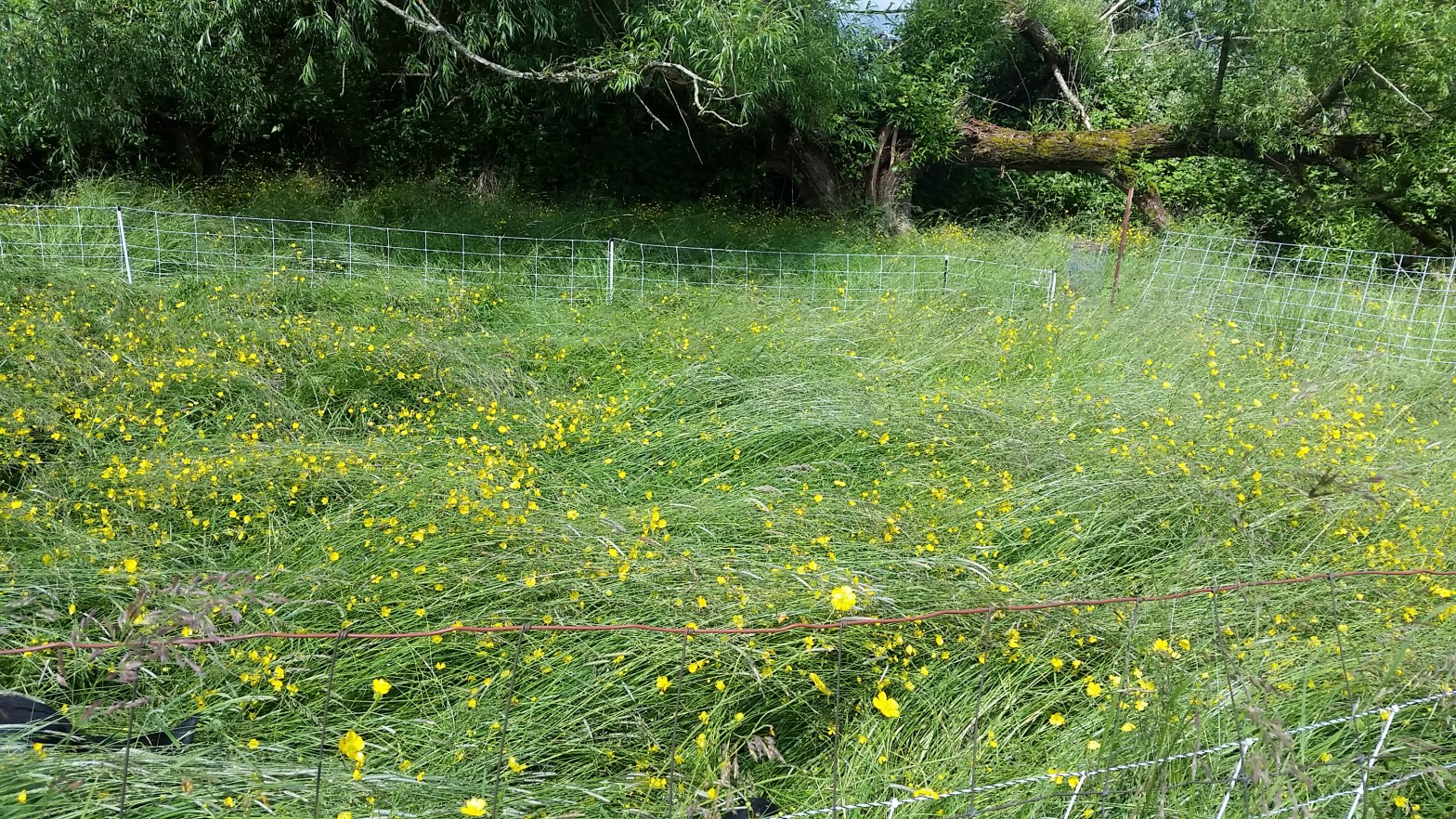
We quickly realized our mistake. The front 1.5 acres of our property is occupied by the house, 2 barns, the “guest cottage” (it’s a trailer), chicken coop, dog yard, and garden space. The back 1 acre is a wooded stream. The 4 acres in between is pasture. In May in Western Washington, that means waist-high grass and buttercup, with some sedges and cottonwood seedlings taking hold here and there. Around the perimeter, Himalayan blackberries (a horrible invasive species) march steadily onward, where they envelop and short out our electric fence and threaten to take over the farm if we look away for even a moment.
Cows would have helped.
Pasture needs to be managed. If you just let it go, then northwest natives and aggressive invasives quickly start to take over. If you want to keep land in pasture, then you have to do something to keep it in pasture. Many people who have large pastures and no livestock opt to have it “hayed.”
At first this term confused me, since we don’t have hay. I thought it would be deceptive to advertise on Craigslist “come hay our field!” when in reality we have grass and buttercup. Then someone kindly explained that haying a pasture is the act of cutting it, drying it, and baling it. It doesn’t have to be of the hay species, and many animals will still eat it. But our grass/buttercup mix is not very high value, so we shouldn’t expect to make money off of having it hayed.
Cutting/mowing/haying a field is good for it. It whacks down undesirable woody natives, like cottonwood, and mowing increases stem density of grass. But it’s a lot of work to mow a field as big as ours, especially once the grass is waist high. And we don’t own a tractor. There’s also energy stored in that plant matter, and it seems wasteful to give it away.
Permaculture principles say that when you have a problem, instead of asking yourself “how can I eradicate this,” ask yourself “what can I add?” In our situation, at this current moment at the height of the growing season, our question is “what do we do with all of this grass?”
We’ve been on the farm 3 weeks. We’re not unpacked. We have boxes of backpacking gear still taped up in the basement; we have clothes stacked on top of bureaus that don’t yet have a home in drawers; we have stacks of framed art piled against walls in every room of the house. I had vowed “focus on zone 0 (the house) and zone 1 (the veggie garden). Ignore the pasture, it will wait.”
But suddenly it seems urgent. So I started researching animals that could help us out. I learned that goats “browse,” whereas sheep “graze.” We need a grazer, e.g., a lawn mower. So goats are out, for now.
Next I started researching sheep. Sheep come with their own unique set of problems. For example, if they’re dairy sheep, then they have to be milked twice a day, and I do not have that kind of time. If they’re meat sheep, you still have to shear them. In the winter, they’re a muddy miserable mess, and all of that wool gets infested with the same bugs that attack your stored blankets and rugs. And really, I don’t like lamb very much, nor do I like sheep milk. Sheep would help us manage our grass, but I don’t care for the product.
You know what I do like? Bacon. And lard. And hams, pork chops, and sausage. But pigs didn’t solve the puzzle either. They root into the dirt in pursuit of bugs, mice, and snakes, and in the process they often churn up grass. But they don’t eat it.
Or do they???
There are 2 heritage breeds of pigs that are popular among permaculturists and homesteaders: the kune kune, and the American guinea hog. They’re popular because they’re smaller than the conventional “shires” (berkshire, yorkshire, hampshire), and they consume very little hog feed. Instead, they thrive on kitchen scraps, and most importantly, they eat grass. That’s right, they graze.
I could get a lawn mower and bacon in one animal. The perfect answer.
Kune kune are funny little creatures, with interesting coat variations and little wattles poking out from their chinny chin chins. They will also set you back a couple grand for a breeding pair, and they’re too expensive to buy as “feeders.”
A “feeder,” I learned, is a weaned piglet you buy with the intention of raising it to slaughter, usually 9-11 months later. In heritage breeds like these, the feeders are often pigs that don’t conform to breed standards for some reason, or aren’t registered. Or they’re dudes. (With livestock, the lady is queen, the dude is often dinner.)
After ruling out the kune kune, I delved into the American guinea hog and discovered that their meat is revered by a few top-tier chefs who have gotten to taste it, and their pure white lard is top quality. In addition to being good eating, they have sweet dispositions. Despite the rarity of the American guinea hog breed, there are several farms in Washington state that are part of the American guinea hog registry. I emailed all of them and asked if they had any feeder pigs for sale, skeptical that I would hear back from anyone.
To my great surprise, they all responded, and they all had piglets available, both feeders and registered breeders. We were getting somewhere.
Josh and I hastily constructed a pig pen out of hog panels and T-posts, and we built a waterer out of a 55-gallon barrel. By now you’ve guessed what was in the neatly bundled box in the back of the truck.
Piggies!
We have 4 boarlets (uncastrated baby dudes). In the 2 days we’ve had them, we’ve learned that they eat the grass, but they love buttercup. These dudes are only about 20 lbs each, and they have nearly obliterated the buttercup population in their 16×16 pen, and the grass is steadily getting mowed down. Excellent news!
We plan to use electrified netting to confine them to a small area, and rotate them to new pasture every few days. This is called intensive rotational grazing, and it has a more positive and controlled impact on the pasture than turning the 4 piglets loose on 4 acres to graze where they will. Once they clear a section of grass and buttercups, we’ll move them onto the next. We’ll sow cover crops in the area they just mowed and tilled–clover, vetch, buckwheat–and if all goes to plan (i.e., if it rains), they’ll get to graze it one more time in the fall. Over time, our pasture quality will hopefully improve.
The piggies seem to be settling in. Two of the four were regularly handled before they came to us, and it took about 15 minutes to discover that they love a belly rub as much as our poodle. The other 2 are still undecided about human contact.
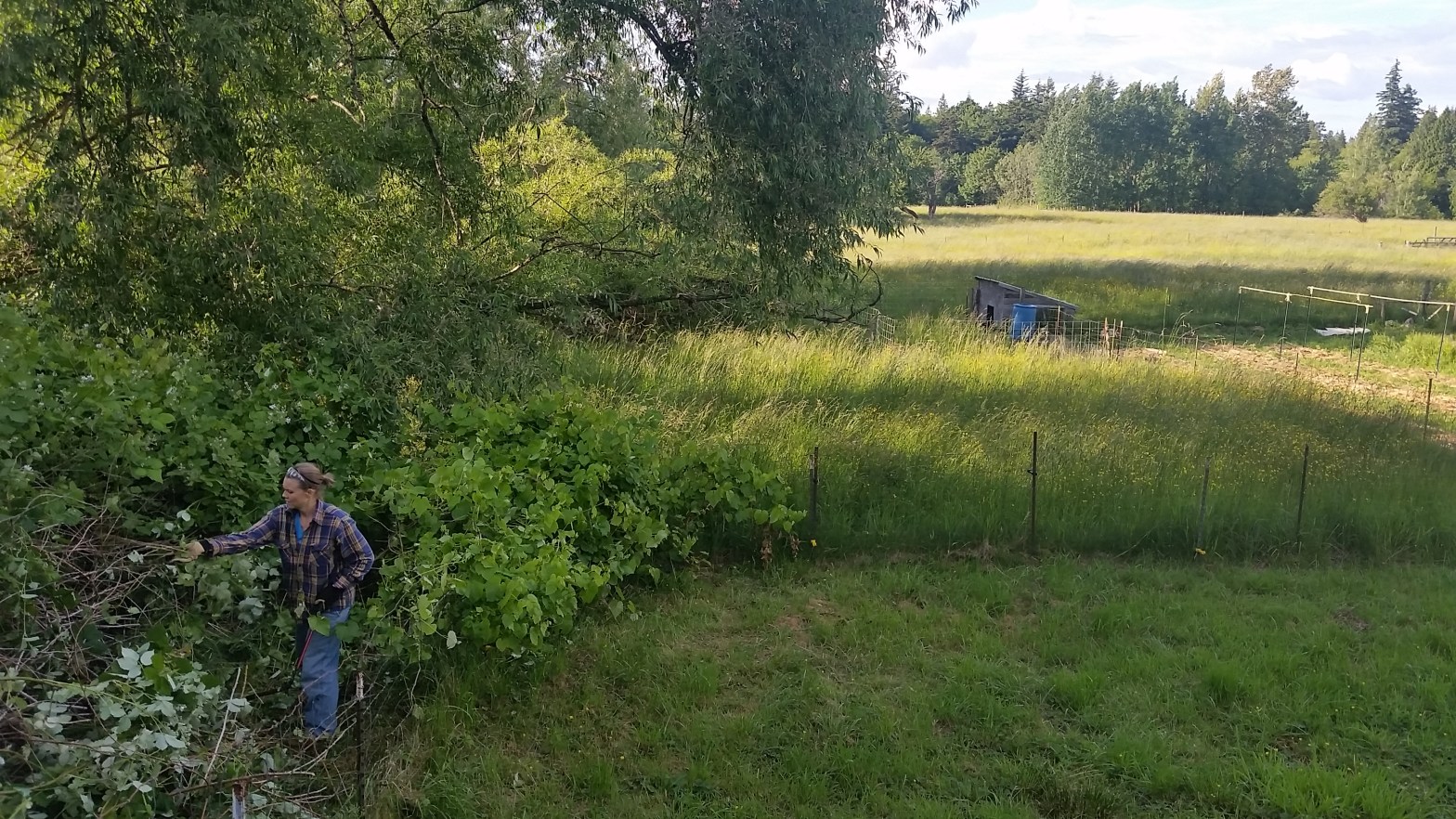
I came home last night at the tail end of a work week to find Gwen knee-deep in a thicket of Himalayan Blackberry. Armed only with loppers and too thin gloves, she was uncovering a trellis of half-buried grapes in a part of the property I had turned a blind eye. (Plus, my neck is still tender from yanking out these buggers on the exact opposite side of the property earlier in the week.) My baby was getting stuff done!
While these particular shrubs do produce a sweet, juicy, and plump (if seedy) berry, they will simultaneously turn you indigo and also shred your epidermis with thorns like a Great White’s third row of teeth. Plus, they are downright greedy!
A couple hours and several splinters later the grapes were liberated from the razor-ous tentacles. I pried out a few more root masses and hung them on the fence as a warning to the others, like Texas ranchers do for coyotes. It was truly a gruesome sight.
Employing my favorite hand tool for moving brush, the potato hook, I was able to gather all the canes into a pile at the top of the hill. Then, through a process of lightly stomping, whomping and turning, a giant vegan blackberry wrap was formed thanks to the seating of all those gnashing teeth.
Gwen is seen here competing in the Blackberry-Burrito-Rolling Games of 2016 as she deftly guides the beast down the slope like the lion tamers of ancient Persia.
This is an example of working smarter (and funner) than working harder. After all, as part-time farmers, we don’t have the time or energy to continue the grind at home.














 Employing my favorite hand tool for moving brush, the potato hook, I was able to gather all the canes into a pile at the top of the hill. Then, through a process of lightly stomping, whomping and turning, a giant vegan blackberry wrap was formed thanks to the seating of all those gnashing teeth.
 Bellfern Homestead