Makin’ Bacon

Josh and I grew up in the Midwest–me in Illinois, him in Ohio and Iowa. At some point in our childhoods, we both came across the game “Pig Mania,” and it’s not because it was a virally popular game at any point in history, not even in the Midwest. It’s a dice rolling game, except that the dice are little plastic pigs. You score points based on the position the pigs land in. A pig balanced on its snout and forehoofs is a “snouter”–5 points. A pig on it’s back is a “razorback”–5 points. If the pigs touch as a result of your roll, it’s called “makin’ bacon” and you lose all of your points and your turn. (Josh recently purchased a 1977 edition of this game in a fit of nostalgia. It’s a fun way to spend 15 minutes every couple of months.)

That was a long setup to say that the phrase “makin’ bacon” is forever fixed in my head as an innuendo. But this post is quite literally about making bacon.

When we processed our first AGH last month, I was very nervous about the quantity, quality, and potential absence of bacon. AGH are lard pigs, not bacon pigs, and one butcher that I called about possibly processing our small-breed pigs warned me, “Well, you won’t get any bacon out of them.” Not get bacon?! I know vegetarians who “make exceptions” for just one meat in all the animal kingdom–and that is bacon. It’s the holy grail of pork. How could we go to the effort of raising heritage pork, butchering it, and have no bacon to show for it?!

I harrumphed and called another butcher, and that butcher did not make fun of my pigs or tell me that bacon was hopeless.

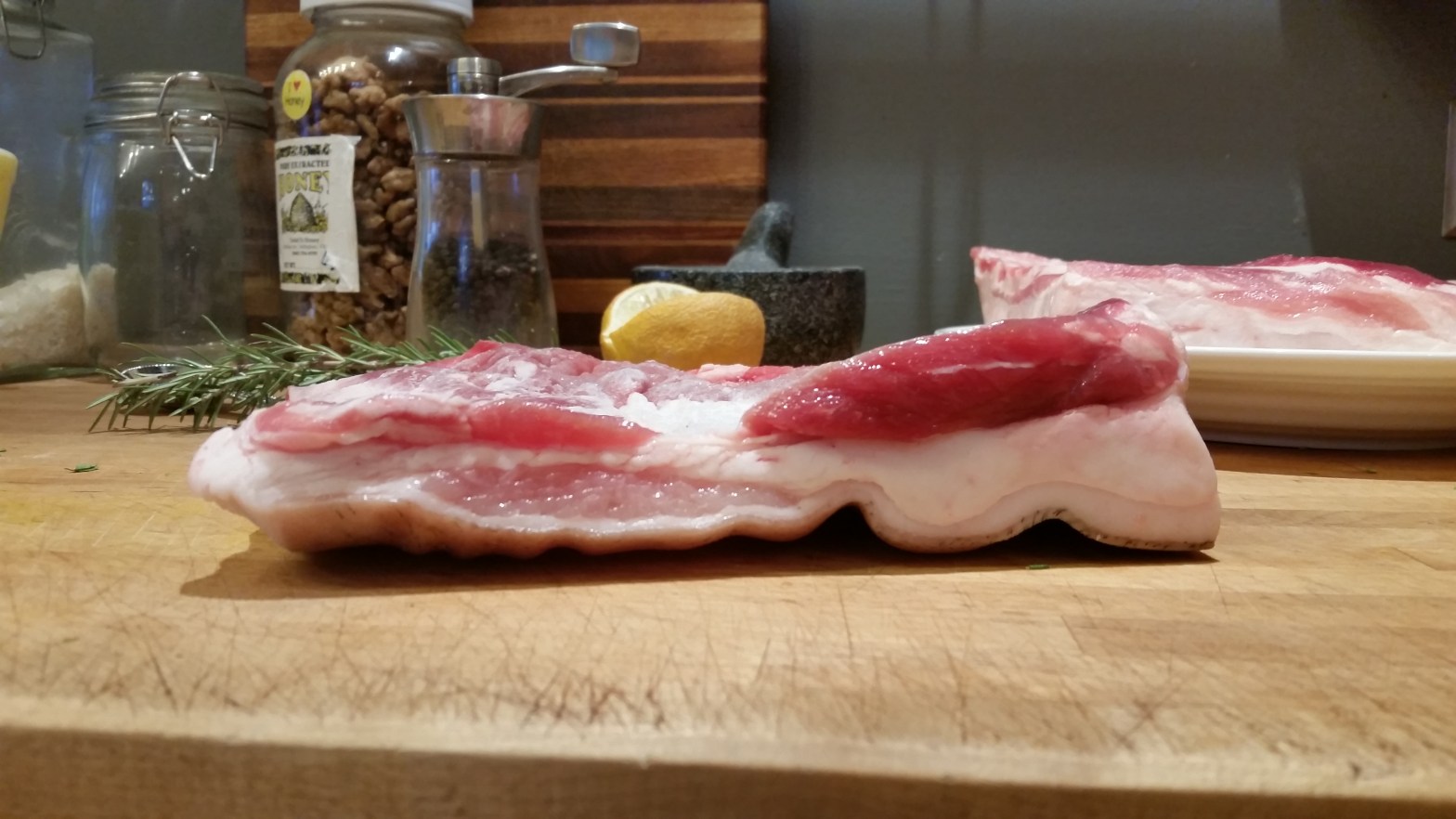
Several weeks later, I got to find out whether an AGH hog would yield enough pork belly to make bacon. It did! Our side of AGH yielded a 6 lb slab of pork belly. Much less than a side of conventional pork, but still a decent size. It’s got a lot more fat than the bacon you might buy at the supermarket, but we expected that. The motto with this pig is “embrace the fat.”

I followed the bacon recipe at Paleo Leap, except that I reduced the salt and tripled the honey (and also subbed it for molasses).
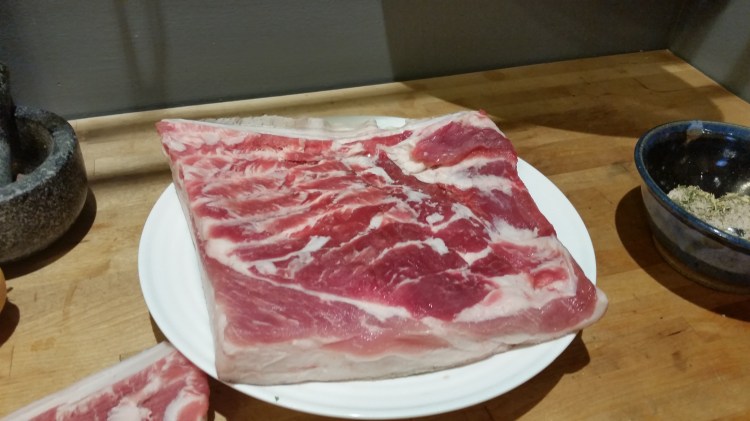
20170401_192601
Raw pork belly. This slab was half of our yield from one side of pork, roughly 3 lb.

The bacon was refrigerated with this dry rub in airless ziplocs for 7 days. After 7 days, I removed it from the liquid, rinsed thoroughly, then dried on a cookie sheet in the fridge for 12 hours.

20170408_092613
Marinated belly, before smoking.

I lit the ceramic kamado grill and held it steady at 200 deg, added chunks of soaked hickory, and then smoked my slab bacon until it read 155 degrees. It took about an hour.

20170408_184824
Smoked to 155 on a ceramic kamado grill.

I let the bacon cool in the fridge overnight, then moved to the freezer for 15 minutes prior to slicing. You want it to be COLD before slicing.

20170409_075747

After all of this work, the taste test was a tense moment. Let me spare you the same suspense.

It’s the best bacon I’ve ever tasted. Truly. It’s $18/lb bacon. It’s Gordon Ramsay bacon. It’s oh-my-goodness, I’ll-suspend-my-vegetarian-diet-for-this bacon. It’s a win.


Shoulder Season Hog Keeping

Back in the day, pigs used to be let loose in the nearby woods to forage and fend for themselves all year, then harvested in the fall/winter. They were referred to as “mortgage lifters” due to the low input to high output qualities. Our woods are far away and there’s a creek in there with salmon restoration measures in effect that preclude any livestock whatsoever.

We are raising pigs on pasture, which means corralling the herd with electro netting and moving them as frequently as possible–known as rotational grazing. But with 40+ inches of rain per year and clay-ey soils, it isn’t easy to keep the pasture . . . pasture. American Guinea Hogs (AGH) will mow quite nicely, tearing mouthfuls of grass left and right, but when they find soft spots of thick buttercup, they quickly utilize their spade nose to dive below grade.

I haven’t fully worked out what all they glean down under, but I’m sure they grab a healthy amount of worms, grubs, roots, and tubers. What you end up with are depressions, bowls, wallows, and other such ankle breaking formations. They are superb at tilling!

Due to 10 inches of rain in October 2016, the pigs were destroying our pasture. We don’t have a tractor, so tilling, harrowing, and reseeding is a major undertaking that we’d like to avoid. So we moved the herd to an isolated area on high ground. This is known as a sacrifice area, because other than the most established perennials, you are sacrificing any and all vegetation. In order to cover the earth and avoid pugging the soil (or, completely pressing out the air), we started with spreading hog fuel (ground up logging debris), then have been adding hay and straw consistently.

AGH are a small breed, so their hoof-print is fairly light. But, man can they poop! Believe it or not, we are scooping the poo and composting it regularly to keep the nitrogen/carbon ratios in balance, which has the added benefit of destinkifying the sacrifice area, much to the appreciation of our neighbors.

Because the pigs decimated the grass in the sacrifice area very quickly, we’ve been feeding fermented grain, alfalfa, and barley as well as giving kitchen scraps throughout the winter and early spring. But, now that the spring growth push has begun, the pasture has come back to life. The grass is growing fast, but the ground is still too wet and soft to put the pigs on it. They can still do too much damage.

But these pigs thrive on grass, they love it, and we have it in abundance. What to do? Bring the grass to the pigs. The porkers have been getting a fresh cut salad pretty much daily. For this I use a scythe to slice swaths, then rake it up into a cart or wheelbarrow, drive it over, and shower the piggos in green gold.

They eat up probably 80 percent of it and trample the rest which then becomes food for all those underworld critters. So far, they are easily keeping up with the piles. It is quite satisfying to watch them chew and grunt in contentedness.


The fruits of winter, part 2: cider

This winter sucked. Ask anyone from the PNW. It was colder, snowier, and blowier than most of the old timers ever remember for this region. We’re finally getting some glimpses of spring. Our grass is growing, nights are staying above freezing.

You know what I liked about winter? I liked that I left for work in the dark and came home in the dark, and that severely limited the amount of farm work I could do, and vastly increased the amount of rest and downtime. I read books. I watched Seasons 1-4 of Star Trek Next Generation. I drank homemade hard cider.

the harvest
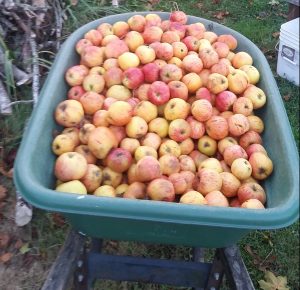
This is approximately one day of fallen apples from last September.

Since we have ten apple trees, we decided that the best way to preserve them is by making cider–both fresh and hard. Last fall I bought a cider press for Josh’s birthday. It was the cheapest grinder/press combo I could find on the Internet, and I bought it in spite of an average 2.5 star review. We used it three times and pressed 10 gallons of cider, after which it fell apart. Happy birthday, sweetie.

Fortunately, I was able to send it back. Unfortunately, we had other financial priorities and couldn’t drop a grand on a new apple press. My dad–who can build anything–suggested that we might be better off buying the metal parts as a kit and just building it ourselves. I hemmed and hawed until my parents (lovely people, you should meet them) offered to gift us the hardware kit and my dad would walk us through the press design and construction.

We got the iron and steel components from Pleasant Hill Grain, and we were able to get most of the lumber (primarily oak) from our local building salvage store. It took most of December to build and finish, but it was below freezing outside so all of our digging projects were on hold anyway.

The result is an heirloom quality piece of equipment.

apple press

wp-1486793716263.jpg
The chicken was not included in the kit.

We designed the press to fit the grinder on the back side, so we could grind the apples then slide the basket to the front for pressing.

Josh at work
The design has changed little in 200 years.

It works beautifully. We had 5 crates of apples stored in our shop during the winter. They had frozen, thawed, and frozen about 3 times, and by the time we pressed them their juice was syrup sweet. So not only did we have freshly pressed apple cider in January, but the batch of hard cider I began in October was bottled and aged and was ready to drink, and it’s wonderful. Crisp, dry, fruity, and lightly oaked. I can’t wait to do it again next year with our new press!

Cider made winter tolerable. But still, I can hardly wait for spring.

wp-1486698477196.jpg

Oh my scrapple, we’re homesteading now

My friend John used to live on a blueberry farm. He loves to tell the story of the day his truck got stuck in the infamous mud of the Pacific Northwest, and his neighbor, who lived on a hill that looked down on John’s property, watched the scene with amusement for a good 20 minutes before coming down with his own truck and a winch to help John pull the truck out. They laid belly-down in the mud together, working to secure the hook to the truck, covered head to toe in PNW clay, and the neighbor paused and said wryly, “We’re farming now!”

I can’t tell you how many “we’re farming now” moments we’ve had since moving to Bellfern, but oh my, it’s nearly every day. Whether I’ve stepped in pig poop on my way out the door to go to work, or my face is splattered in blood on processing day, farming “gets real” more often than not.

The same can be said for homesteading. Now that we’ve processed our own pork, my evenings are full of homestead-y chores like rendering lard, curing hams, and making scrapple. Yes, scrapple. Bear with me.

In addition to pork chops, ribs, roasts, and bacon, our pile of processed pork included the head. And since we asked the butcher not to skin our pig (we want the skin on our hams and roasts), the head really looked like a head. The same one I scratched and petted, minus an eye and an ear. There was no way to pretend it was anything else.

The traditional thing to do with a pig head is make head cheese, but, gross. The other option is to make scrapple. Scrapple is essentially meat loaf that is bound with cornmeal, and if you don’t want the details then stop reading now.

Online recipes for scrapple are written in pretty broad strokes, because it’s made of basically whatever scraps of pork you have leftover–usually the trotters and organs. Or a head, for example.

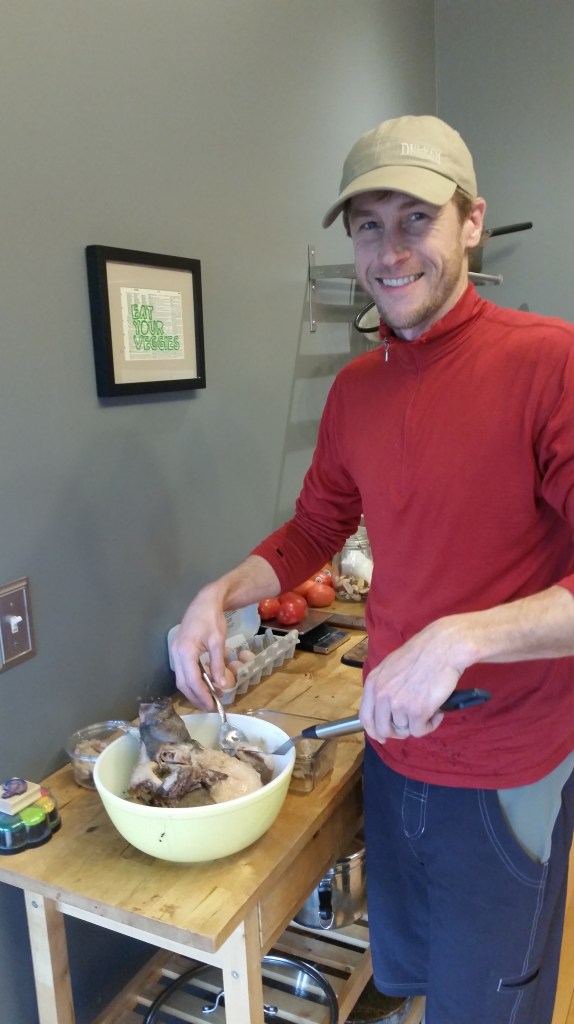
We started by boiling the head for hours until the meat was falling off. Because I was attached to this particular pig (Big Boy), Josh was assigned the task of scraping off the skin. After removing, he cut the skin into strips and cooked it on a baking sheet in the oven at 250 degrees for nearly 24 hours–which resulted in cracklins. If you zoom in, be warned. That’s a boiled pig head.

wp-1490933586075.jpg

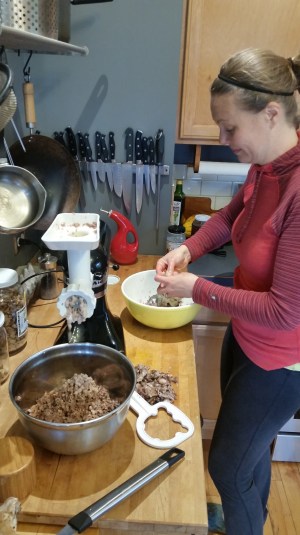
I then picked the meat and fat off the skull, removed the weird gray bits (set aside for the chickens), and ran it all through the grinder.

wp-1490933586076.jpg

In case there’s any question about how I felt about this process, let’s zoom in:

wp-1491105956103.jpg

See that face? That’s the “we’re homesteading now” face.

The ground meat, fat, and onions are then returned to the pot with a few cups of broth, and cornmeal and maybe buckwheat flour are added, along with salt and sage. This is all stirred over low heat until it’s the consistency of a stiff dough (the English would call it a pudding), then poured into loaf pans and chilled. To serve, you slice it and fry it over low heat until crispy.

It’s mind-bendingly delicious. I’m not sure how I’ve lived 35 years without scrapple. I can’t say I enjoyed making it, but I was happy to use every scrap of that pig. And the skull that was left after I picked off the meat was then boiled for 3 days in the crock pot, which softened the bone enough to crumble it into a meal that we fed to the dogs and chickens. The only thing left of that pig was its teeth.

Free Range Chickens: Little Vulturous Destroyers

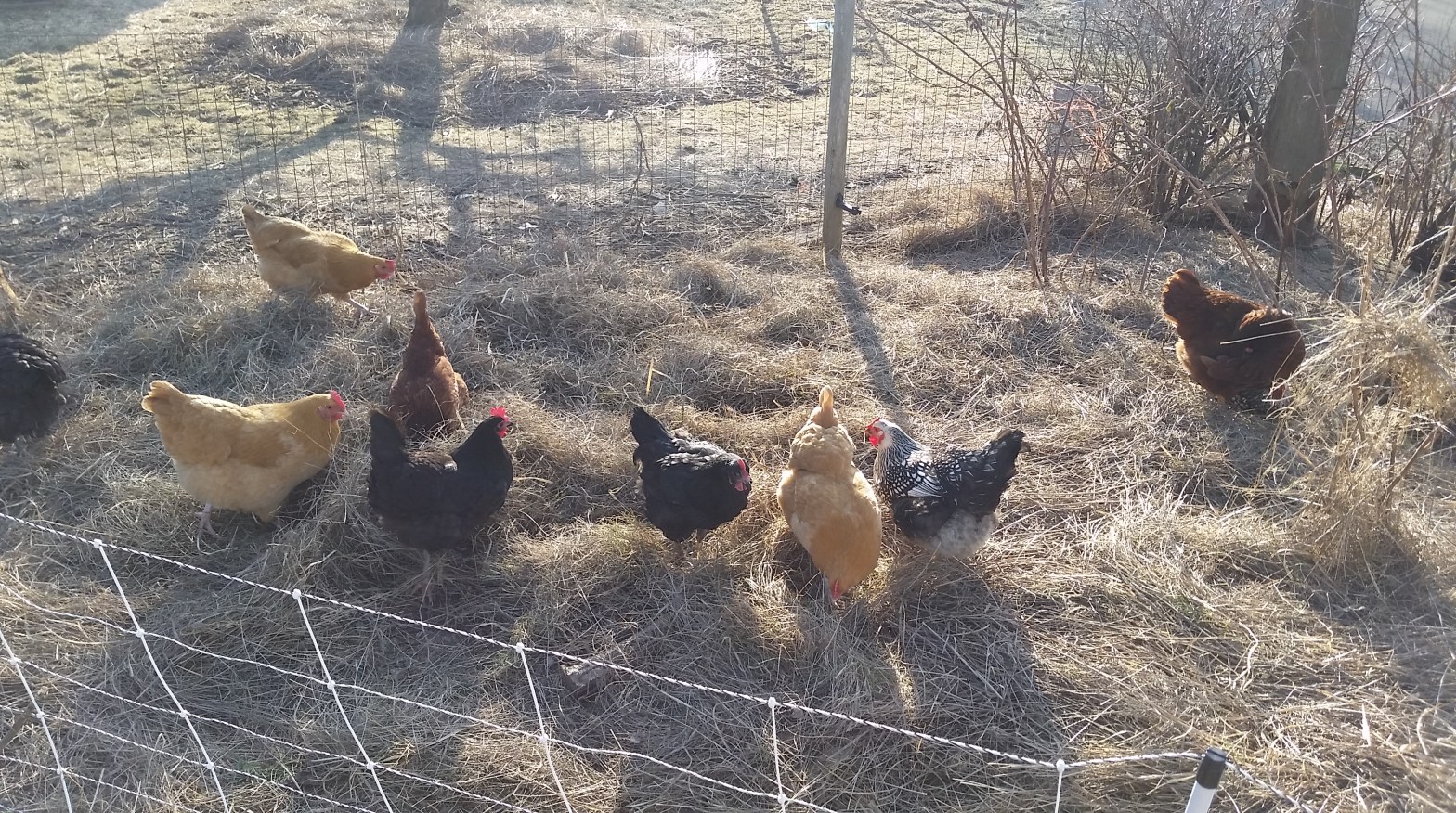
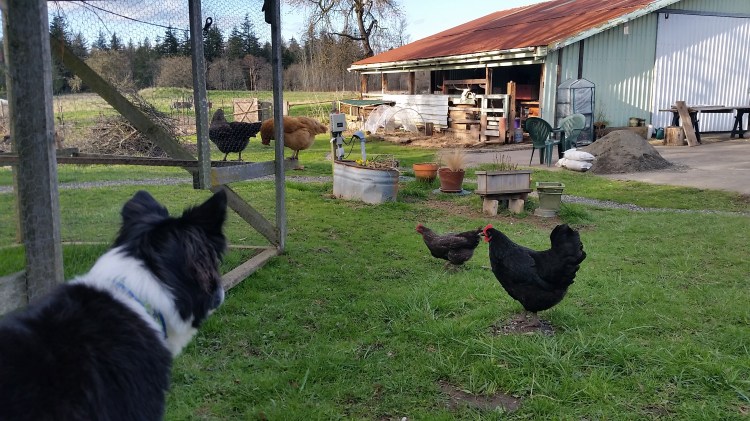
Our chickens are tireless. They’ve got serious moxy. They laugh at fences, sleep in trees, and throw large sticks aside in search of anything that moves. One day I came home to rubbermaid bins and chicken feeders broken on the barn floor because some bird was looking for a new nesting spot.

wp-1491186820469.jpg
Wild thing.

We keep them cooped at night for their own good, but they’ve got an automatic door opener that reads the first crack of dawn and the Australorpes frequently make it to the compost bin before I’ve oriented myself to the coffee grinder.

I’ve been cutting hay/thatch for months now and adding it to the various beds in hopes of smothering weeds and raising the soil organic matter to increasing fertility and hold moisture. The chooks absolutely love what lurks underneath. Spiders, beetles, bugs, centipedes, you name it! I snicker when I read those store-bought egg packages that read, “Vegetarian Fed.” If you want to see a feeding frenzy that rivals Great White sharks, toss a steak into a flock of hens. Its a blur of feathers and feet!

Yesterday, I took down the awful tasting ancient apple tree that used to be their nocturnal haven. Then, I used that wood to edge one of their favorite garden beds. One of many that they would un-mulch and cover the walkways killing the grass and making for winter muck.

wp-1491186731934.jpg
A little edging goes a long way to having clear paths. 

These ladies will tail me if I’m carrying a shovel. The know that freshly upturned soil harbors worms galore. So, its a real challenge when planting. And a REAL challenge when seeding something. I’m so sure they’ve got veloceraptor vision and can sense the energy signatures of seeds on, above, or even below ground.

Sometimes I will distract them with a pile of dried mealworms on the other side of the barn just so I can have some space. Fencing is helpful, but they fly with relative ease (relative to myself, I suppose), so proper barricades need both a top and sides.

wp-1491186731936.jpg
This apple has only been in the ground a few hours. Do you see them scheming?

Once established, plants are pretty safe. I’m considering using milk cartons as cloches while my transplants mature. Chickens are a lot of extra work, but…the eggs. The eggs are incredible. So dark. So thick. So orange.wp-1491190807252.jpgAnd they are kinetic and sonic yard art. Fun to look at and listen to. Kids are naturally drawn to them. As are dogs. As am I.wp-1491186856224.jpg
The day pig becomes pork

People who know me describe me as practical, no-nonsense, tough. (I’m sure there are other adjectives, but those are the ones relevant to this story. Hush.) While the pigs were growing, people frequently asked me whether I’d be able to butcher the them when the time came, since I frequently told stories about the pigs rolling over for belly rubs, or nuzzling my leg for ear scratches. Unwaveringly, I responded that we aren’t feeding these animals to be pets, and yes, it’s hard, but that I think it’s good to be up close and personal with the exchange that takes place when we humans agree to eat meat. One life for another.

But when butcher day came, I surprised myself by being pretty torn up about it. It was hard. I cried. I was not tough.

We butchered 3 of our 4 American Guinea Hogs on March 15. And by “we,” I mean we outsourced that. The local butcher came out to our farm and shot and bled the animals on site, then brought them back to their shop to chill and cut. I spent butchering day at my office, trembling and anxious, but Josh said the guys who came out were calm, professional, and efficient. They minimized stress for the animals as much as possible, which is what we wanted.

Once it was over, no-nonsense, in-control-of-herself Gwen returned.

We sold 2.5 of these pigs, and kept one half for ourselves. I was amazed and grateful that we have friends who took a chance on us and bought our pork, since we didn’t have anything to recommend this breed but internet heresay. (There are some snout-to-tail chefs who swear AGH is the pork.)

In the weeks leading up to butchering, I was working hard to moderate the expectations of our few customers about this pork. The pigs are small,” I warned. “Small chops, small bacon, small hams. And it will be fatty. Really fatty. Embrace the fat.” My inspiring marketing pitches betrayed my fears and doubts. What if the yield was laughably small? What if our customers looked at their pile of cuts and thought they didn’t get their money’s worth? And what if, oh dear, our pigs had taint?

(Footnote: taint is somewhat common to uncastrated male pigs [though less common to AGH], and it has to do with dude hormones. Not all boars have taint, and not all people can taste taint even on pigs that have it. But for people who can taste/smell it on pigs that have it, it’s described as horrendous, stomach-churning, and vile. Most people use tainted meat for dog food. By not castrating our boars, we knew we were taking this risk.)

With tremendous relief, we picked up our half from the butcher and discovered that it tasted wonderful, better than I could have imagined, and the yield was respectable given the size of the pigs.

Our pig had a ~135 lb live weight, 96 lb hanging weight. Because we kept the bone in all cuts, and kept most of the organs, the cut and wrapped weight for our half (40 lbs) was very close to the hanging weight. Nothing wasted. Here’s a breakdown of the cuts and their weights, to give you an idea how much a half an American Guinea Hog will yield:

6 lbs, 7 oz pork chops
2 lb, 4 oz hocks
3 lbs spare ribs
1 lb, 5 oz leaf lard
1lb, 9 oz back fat
9 lb, 8 oz shoulder roasts
6 lb belly/bacon
9 lb ham
3/4 lb ground pork
40 lb Total

Plus 1/2 head, 2 feet, 1 ear, heart, and liver. And I’ll be grinding some of our roasts into sausage.

There was more demand for our pork than we could meet, so we’ve already introduced 5 new piglets to Tugboat, our barrow who was left behind in the first round of butchering because he wasn’t big enough. Two of these piglets will be our new breeding pair, and we’ll butcher the other three this winter.

wp-1491065960452.jpg
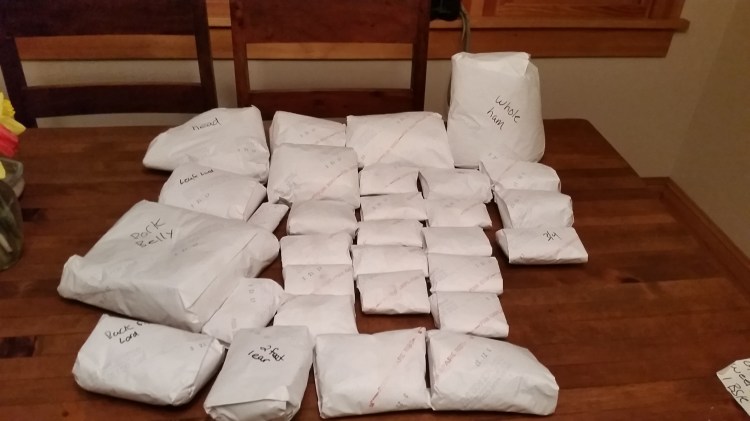
Half an AGH pig, cut and wrapped.


Cover the Earth

If there’s one rule I am following while attempting to bring the soil here back to life after decades of neglect, its this: keep it covered. All the little crawlers, fungi, and beneficial bacteria present in healthy soil can’t stand direct sun, too dry, or too wet. Like us they respond quite nicely to sturdy shelter, delicious food, and good company.iunematodebacteria

These under-sung life givers simply can’t thrive when churned up into powder by the tiller tines. But, that’s what conventional and even some organic agriculture does over and over and over again. I see it on my daily commute. The fields are plowed, then disked, then artificially fertilized, then planted, then herbi-pesti-fungi-cided, then harvested (yum!), then left to wash away during our 40 inches of winter rain.

Its insane. Its murderous. There’s barely anything living above or below the surface. How do we expect the food we rely upon to do well in that barren environment? Might as well be a desert here in the temperate rainforest.

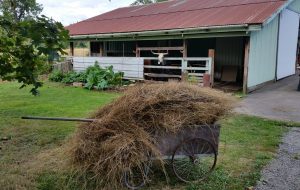
Anyway, back to Bellfern. Our soil is highly compacted, highly acidic, clayey, and otherwise starved for nutrients. So, I’ve been adding mulch where its bare. For this I am using what I’ve got: scythe-cut-hay and pulled weeds mostly. I’d love to use wood chips as they don’t disappear as quickly, but I don’t yet have a source.hay_wagon.jpg

Where the ground has been disturbed whether by rooting pig snouts or my magna grecia hoe and when the temp is right, I’ll spread a nice thick cover crop. This is a lush mix of soil building plants that I can let go or cut down for a green manure. Ours includes daikon radish, clover, buckwheat, vetch, and other quick growing nitrogen fixing, pollinator attracting, or naturally tilling plants. wp-1490156070673.jpg

Hilariously, or perhaps disturbingly, the title for this post comes from the Sherwin Williams logo which shows  what appears to be a bloody bath given to our globe. Cover the Earth? Yes, I believe I will.

P.s: Dear SWP, it is high time for a re-brand!

cover the earth


The Myth of the Self-Sufficient Homestead

“If I have seen further than others, it is by standing upon the shoulders of giants.” – Isaac Newton

Many people start homesteading because they want to increase self-sufficiency, and decrease dependence on systems that seem fragile or likely to fail. Should The Big One strike (referring to the devastating and periodic earthquake along the Cascade Fault of western Washington that’s 300 years overdue), public utilities, cell phone towers, roads, and railways may become unreliable or fail altogether. The systems our modern society has designed to keep us clothed, warm, and fed could fall apart. There’s a fine line between homesteaders and preppers, and for some people there’s no line at all.

While I do think it’s valuable to recapture the knowledge of the “old ways”–ways that didn’t depend on electricity, refrigeration, and rapid transportation–self-sufficiency has never been a primary reason I wanted to homestead.

I think self-sufficiency is a misnomer. Since we moved to the farm and started raising a large amount of our own meat, fats, and vegetables, I’ve become more dependent on my community than I ever was as a town-dweller.

Even if we produce 100% of our own food someday, we will never be self-sufficient. We rely on my dad to tell us how to fix pretty much everything that breaks. We rely on the farming listservs and Facebook groups in our county for information, resources, networking, and supplies. We rely on friends to help us tackle difficult projects, like butchering chickens and moving fencing. We rely on YouTube to teach us how to do obscure stuff, like proper scything technique and piglet castration. The more “self-sufficient” we become, the more reliant and embedded we become in our community.

The Internet is invaluable in this regard, and is perhaps the achilles heel for all of us homesteaders and preppers. If the Internet ever fails, I’ll be in a pickle. Through an ad for hay on Craigslist, we met Bridget, who is managing a homestead single-handedly and efficiently, and quickly became a mentor to us.

I also met Brianne on Facebook through a local farmers group. She was selling AGH piglets, and after a few exchanges I learned that she and her husband did their own butchering. Awed and a little afraid, I asked if they’d ever let us watch. She agreed and invited us over last weekend, where I got to watch a hog butchering from start to finish. I learned a ton, and I met a smart, innovative, and tough couple as a result. And to our surprise, Bridget was there when we showed up for the hog butchering, because we live in the kind of place where everyone you know is just one step removed.

On Facebook groups, I’ve also met experienced farmers who dole out advice and wisdom whenever greenhorns like me need it. One particular old-timer farmer on my American Guinea Hog  Facebook group is extremely knowledgable about these unusual pigs, and he regularly chimes in with sage advice on nearly every thread. His experience (and willingness to share it) is gold, and in a recent online conversation I told him so. His response? “I stand on the shoulders of Giants.”

I  couldn’t agree more. I hope I can someday be a giant for the next generation of small-time farmers, but for now I’m the one perched atop, and very, very grateful for the expansive view and their support.

The moment Bellfern began

2-23-16-email

I know, I know, it’s the most boring email exchange ever. It’s so innocuous, so bland, so void of significance. But you know what it is? Of course you do. It’s the first email exchange (a hundred would follow) between me, Josh, and our realtor about Bellfern Homestead.

But of course it wasn’t Bellfern Homestead yet, it was just a property that we saw listed on Trulia, for sale by owner, and drove past one Saturday morning–something we’d done for a dozen listings over the past months. After our drive-by, we both kind of shrugged–you couldn’t see much from the road, except an absurd number of outbuildings, including a very trashy looking trailer (it would become the chateau). I can’t say either of us was excited or even very interested after that first drive-by.

Of course you know what happened next because we’ve been blogging about it for the past year, but what I love about this email, this snapshot in time, is that we did not know. We had no idea that when we viewed the house on a Thursday evening after work that we’d walk out onto the middle pasture and feel a certain settling in our stomachs, a certainty that yes, this was it. We didn’t know that our offer would be accepted even though it wasn’t the highest; that the closing process would miraculously sail through appraisal and inspection in spite of some glaring oddities (again, the chateau), that our own house would sell the instant we listed it with a cash offer that would make the whole thing possible.

I wanted to share this little exchange with you (which occurred one year ago yesterday) because it pinpoints the beginning of an era for Josh and me. I’m reminded that every significant decision in my life can be traced back, back, back to the beginning, and almost always, it starts with a casual conversation, a nearly thoughtless decision, a moment so banal that it wouldn’t otherwise be remembered.

What’s your origin story? Consider a significant decision or life event and see if you can trace it all the way back to the moment that set you on that course. Leave a comment with your story, if you’d like!

Homesteading is not as sexy as it sounds

Maybe you have a fantasy about homesteading someday, and you have a vision of yourself wearing flannel and Carharts harvesting mountains of winter squash for your root cellar, and hosting apple cider pressing parties with your neighbors. You envision raising pastured cattle, who happily much on your luscious green grass, and you imagine quaint daily chores of animal feeding; maybe weekends spent planting seedlings or pruning.

Those things are all true, I’m not going to completely deflate you. But I want to give you a picture of the other side of homesteading, one that’s not quite so quaint, a.k.a., a more typical weekend.

Josh and I slept in until 7 (scandalous), and after a hearty homestead breakfast of sautéed veggies and scrambled eggs, we both dove into our respective weekend projects.

Josh

We had a miserably cold, icy, windy, and snowy week that downed lots of branches and a couple of whole trees. A blizzard on Wednesday was followed by 50 degree weather and pouring rain on Thursday, and 8 inches of snow melted in 36 hours. As a result, much of our land is under standing water.

wp-1486878940710.jpgJosh’s task was to dig some drainage ditches in hopes of drying out the saturated lowlands a bit faster, and also to move water away from our septic tank, which has set off a scary air-raid siren-type alarm 4 times in the past 30 hours–an indication that the pump cannot keep up with the water coming in.

He, with the help of a very good friend, dug 60 feet of trench, and shoveled a small mountain of sopping, saturated, clay-ey soil out. They then laid drain pipe and filled the whole ditch with gravel.

This fun task was broken up by a brief game of Whack-A-Rat at mid-day, which brings us to Gwen’s weekend project.

Gwen

Gwen declared war on the rats. We’ve had a couple of skirmishes in the past, but the rats are winning. They have an extensive network of tunnels underneath the 60’s era chicken coop, which is home to at least a dozen Norway rats. They chewed through the floor of the coop in order to gain 24-hour access to the chicken feeder, and every time Gwen stapled chicken wire over their holes, they chewed new ones the next day. In a 24-hour period, they emptied a 5-gallon feeder of chicken mash.

We are not in the business of buying organic groceries for rats, and the chicken feed bill is going through the roof.

Plan of attack: Stage 1: kill as many rats as possible. Stage 2: seal off access to the coop. Stage 3: remove any food that isn’t bait for a rat trap.

After throughly cleaning out all of the coop bedding (and removing the chickens), Gwen shoved a couple of smoke bombs into the rat holes in the coop, which caused the rats to scurry toward their exits where Josh and friend were waiting with a shovel and pellet gun. They dispatched at least 5, and hopefully the smoke got a few more.

Gwen then stapled 1/2 in hardware cloth to the floor of the coop, and then laid a new layer of 1/2 in plywood on top of that, followed by fresh bedding. She removed the chickens’ food for the night, secured it in a metal drum with lid, and Josh set fresh rat traps.

In the midst of these 2 big projects, we also mixed feed, hung some mason bee boxes, scooped poop, cut winter hay from the field, fixed fencing, ran errands, and spread fresh hay for the pigs.

That was Saturday, and I’d say it was half of a pretty average weekend. Tomorrow we’ll chop up the fallen trees, devise more rat traps, wax bee foundations, and…

Just so you know. Homesteading is not glamorous, but it is deliciously flannel.